From Protection to Politics: Who Will Save J&K’s Forests Now?
Chief Minister’s Office has triggered a wave of debate across Jammu & Kashmir. The government has designated the Tribal Affairs Department as the nodal agency for implementing the Scheduled Tribes and Other Traditional Forest Dwellers (Recognition of Forest Rights) Act, 2006, taking the responsibility away from the Forest Department.
While the CMO has framed the decision as a “long-pending demand of tribal communities” and a step towards “more effective implementation,” environmental observers, and land-rights researchers say the move could have serious consequences for the already-fragile forest belts of J&K.
A Shift That Alters the Balance of Power in Forest Governance
The Forest Department has historically acted as the primary regulatory body responsible for:
preventing illegal encroachment,
monitoring deforestation,
and protecting biodiversity across the UT.
With FRA implementation now placed under the Tribal Affairs Department — a welfare-oriented department with a political mandate — experts fear that forest conservation may take a back seat.
A retired forest officer, speaking to The Wular, described the move as “a complete dilution of regulatory oversight,” warning that it could “open the door to unchecked regularisation of already encroached land.”
Encroachment Patterns Already a Serious Concern
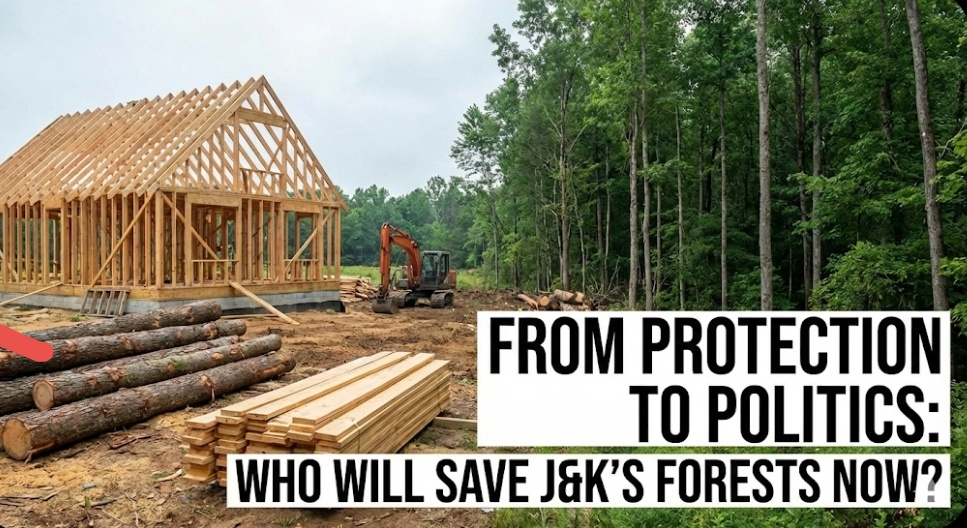
In multiple forest belts, documented surveys over the last decade have shown patterns where:
forest land was first cleared,
then illegally occupied,
and in several cases, sold informally at very low prices to influential buyers.
These patterns are widely discussed at the local level, though formal investigations often remain incomplete or inconclusive.
Environmental groups argue that removing the Forest Department from the FRA process weakens a critical institutional counterweight that previously scrutinised such claims.
Fear of Accelerated Regularisation of Encroached Land
Critics say the shift may encourage a new wave of encroachment, because:
1. People may expect future regularisation of whatever land they occupy today.
2. A welfare-focused department may be pressured to approve more claims.
3. Local political actors might treat FRA rights as a tool of constituency management.
These concerns become sharper in regions where deforestation has already altered the landscape.
In the words of a “The Wular” writer from Srinagar “Once the Forest Department is not at the centre of the decision-making system, the line between rightful claims and opportunistic occupation becomes thin.”
Demographic and Ecological Impact Cannot Be Ignored
Environmental analysts warn that the move may:
permanently change land-use patterns,
expand human settlement deeper into forest interiors,
accelerate slope erosion and landslides,
and alter the demographic distribution in eco-sensitive belts.
The worry is not about the rights of legitimate traditional forest communities — which the FRA seeks to protect — but about exploitation of the Act by opportunistic encroachers and intermediaries who convert forestland into private real estate.
Conclusion: Rights Must Not Become a Cover for Misuse
Forests in J&K need stronger protection, not reduced oversight.And any governance reform that impacts land, ecology, and demography must withstand public scrutiny, not circumvent it.